
Did you know the city loves telling residents this line? State law only lets property tax revenue grow 1% a year, so no matter how much your home’s value jumps, the city barely sees a dime more.
Hmmm?
It’s not exactly wrong. It’s just not the whole story.
What’s Actually True
Washington’s Initiative 747 really does cap the city’s base property tax collections at 1% growth a year, unless voters approve more. And it’s true that when everyone’s home value rises together, the city doesn’t automatically pocket extra–the tax rate just drops so the total stays capped.
Think of it like a pizza that’s always cut into the same total number of slices, no matter how much bigger the pizza gets.
What the City Leaves Out of the Story
That 1% cap only covers one slice of the city’s overall revenue pie. Three other doors are wide open:
- New construction gets added straight on top of the 1% cap without needing a vote. Every new house, apartment building, or major remodel adds fresh tax dollars beyond the limit.
- Levy lid lifts – when the city asks voters to approve a higher rate for a specific purpose – aren’t rare exceptions; they’re a regular tool that blows right past the 1% ceiling once approved. An important fact: a levy lid is applied to the current assessed property values, and the revenue it generates is not capped at 1% of that levy year. Furthermore, that updated assessed value becomes the base for future non-lift years, when the regular 1% may then be applied.
- Real Estate Excise Tax (REET) – a tax collected every time a property sells – has nothing to do with the 1% cap. When home values soar and houses keep changing hands, REET collections soar right along with them.
So the honest headline isn’t “the city gets no benefit when values rise.” It’s the base budget doesn’t automatically grow – but the city has multiple other levers that do, and uses them.”
Understanding the 3 Alternative Revenue Streams
- Base Levy (Gray): Capped at 1% per year.
- New Build Addition (Blue): Added directly on top of the base levy as new development occus.
- Lid Lifts (Green): Approved voter increases that raise the base cap.
- REET (Orange): Uncapped revenue tied directly to total property sales volume and value.
Together, these four streams form the complete picture of total property city tax revenue as shown below.
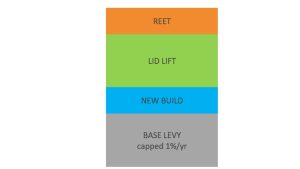
City Property Tax Revenue Stream
A good example of the Levy lift impact is the Safety and Security Levy Lift that was approved in 2023. That year there was an significant 17% increase in assessed property values. So, when the levy lift was implemented in 2024 it was applied to this increased assessed property values and the levy lift then resulted in a 49% increase in revenue generated. Revenues from property taxes increased from $5.6 million to $8.4million (49%).
The Bonus Catch from the City’s Property Tax Explainer
In the city’s official property tax explainer, officials claim that a cumulative inflation rate of 29% since 2020 against a 6% total allowed tax increase results in a 23% loss in purchasing power.
That calculation simply subtracts 6 from 29. However, that isn’t how purchasing power works. Because purchasing power measures what your actual revenue (1.06) can buy relative to inflated costs (1.29), you must evaluate the ratio of remaining purchasing power:
Loss in Purchasing Power = (1.06 / 1.29) – 1 = -17.8%
Do the math correctly, and the real decline in purchasing power is 17.8%, not 23%. They overstated their own financial squeeze by more than 5 percentage points.
(Source: City Property Tax Explainer Link)
Real-World Example: How the Revenue Levers Play Out
Consider a city experiencing a strong housing market in a single year. While the Base Levy is strictly capped at $10 million + 1%, the city simultaneously brings in $300,000 in brand-new revenue from a newly built housing development (New Construction), while dynamic home sales generate an unexpected spike of $800,000 in REET funds. Even without asking voters for a Levy Lid Lift, the city’s actual year-over-year revenue growth significantly exceeds the baseline 1% cap.
Bottom Line
The “starved by 1%” framing oversimplifies. There are three other revenue doors on property tax, and REET is doing real work. The city’s inflation math is sloppy in its own favor.
However, underneath that, the city’s disclosed gap between revenue growth and expense growth remains a real challenge. The fair read isn’t “the city is lying about being broke.” It’s “the city oversold one part of its case while underselling a stronger one.”
Anthony Lee
Anacortes, WA