
On September 30, 2026, roughly 60 to 70 Anacortes residents gathered for a City Council Open House on the 2027 municipal budget. The backdrop for the evening, laid out by Mayor Walters, was stark: the city faces a projected $2.4 million budget deficit in the General Fund for 2027.
To collect community input on how to bridge the gap, the city introduced a visual feedback system designed by the Finance Department. Here is how the evening unfolded—and how the pieces fit together.
The Setup and Mechanics
Each attendee was handed 10 yellow dot stickers upon entry.
Around the room sat display boards for key General Fund departments—including Parks, Library, Streets, Planning, Police, and Fire. Under each department heading, the boards were divided into three explicit columns:
- Invest / Enhance
- Maintain As-Is
- Reduce / Scale Back
Participants were instructed to distribute their dots across the boards to signal their priorities. Sticky notes were made available for detailed written feedback, though few attendees utilized them.
Room Dynamics and Composition
Beyond the voting boards, two distinct operational dynamics were visible throughout the room:
- Attendee Demographics: A sampling of participants revealed a noticeable concentration of active city volunteers, particularly from the Senior Center and Parks and Recreation departments. Several noted that their department supervisors had strongly encouraged them to attend the open house.
- Staff Presence: Department representatives were stationed beside their respective display boards to answer questions.
The Data Visuals
The resulting boards offered a snapshot of public preference under this system:
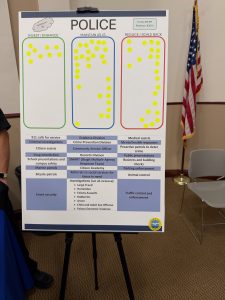
Police Board: Displayed a listed operating cost of $9.8M against $351k in revenue. It received the highest number of yellow stickers (23) favored “Reduce/Scale Back” the department.
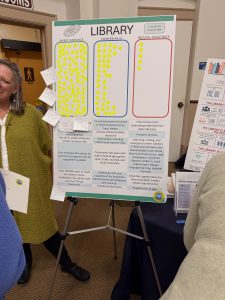
Library Board: Listed costs at $1.6M against $49k in revenue. Received the highest number of yellow stickers (77) favored “Invest / Enhance”, filling the left-hand columns, with almost no dots in the reduction column. Handwritten notes pinned to the margin added comments like “Eliminating the library is not an option” and “KEEP!!!”
Connecting the Dots
When a city faces a $2.4 million revenue shortfall, every dollar allocated to maintain or expand one service requires an equal offset elsewhere.
The Open House structure allowed citizens to vote on individual services. At the same time, the turnout was shaped in part by city department encouragement, and the mechanics asked participants to allocate sticker dots across desired outcomes rather than balance actual line-item trade-offs.
As the City Council moves forward with drafting the final 2027 budget, these boards represent the primary visual record of public input. How well a dot-voting system captures the economic trade-offs of a multi-million dollar deficit remains the open question for Anacortes taxpayers to consider.
Anthony Lee
Anacortes, WA